AI in Tattooing: My Thoughts as a Tattoo Artist
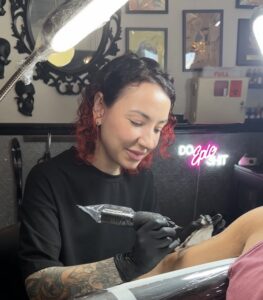
“Do you use AI” is a question we get quite often. Thankfully our resident artist Xenia has been kind enough to write a blog post to help explain to clients how a custom tattoo is created. Hopefully this will help ease some minds and give a better understanding of AI and how it can be used for custom tattoo designs. We DO NOT condone or use AI to create entire tattoos, but it can be a helpful tool. Please read below:
So, my dear friends.
By now, we all know that AI has barged into our lives at full speed. Some people love it, some absolutely hate it, and some honestly don’t care. Everyone has their own opinion, and the tattoo industry is no exception.
Both my colleagues and I have run into situations where people react very negatively to tattoo artists using AI. As these conversations, arguments, and misunderstandings have become more common, I decided to write this article (you know I enjoy doing that from time to time  ) and try to break the whole topic down.
First of all, I want to make one thing very clear. This article is NOT meant to justify the use of AI in tattooing. My goal is simply to show clients what actually goes into creating a tattoo design, because that’s the part of the process you never get to see.
What concerns do clients have when they hear their artist uses AI? Why does it trigger such a negative reaction?
As always, everything you’re about to read is based entirely on my personal experience and opinions. I’m not claiming to have the ultimate truth. This is simply how I see it after years of doing this professionally.
Also… this is going to be a long one, so get comfortable
So what exactly bothers people about AI?
Obviously, I can’t crawl into everyone’s head and know exactly why they feel the way they do. But from conversations I’ve had, and from my own observations, these seem to be the biggest concerns:
1. If AI was used, then it isn’t really a custom design anymore.
2. I don’t want to pay for an AI-generated picture.
3. AI isn’t art.
4. The artist didn’t really put effort into creating the design.
To me, all of these points are closely connected, but let’s keep them separate for now. In the rest of this article, I’m simply going to show you what actually goes into creating a tattoo design. Once you see the process behind it, I’ll let you decide for yourself whether these concerns still make sense.
How tattoo artists actually work
I’d like to start by talking about how tattoo artists work compared to other artists.
Let’s take a traditional artist who paints commissioned canvases. Everyone works differently. Someone may spend a year on one painting, someone a month, someone a week. Regardless, we’re talking about a significant amount of time dedicated to a single piece.
Now let’s compare that to a tattoo artist. Again, everyone’s schedule is different, but I honestly don’t think any full-time professional tattoo artist has fewer than ten clients a month. Realistically, it’s usually fifteen or more.
Now think about what that actually means. A tattoo artist isn’t creating one piece a month.We’re expected to design anywhere from 10 to 30 completely different tattoos every month… and then actually tattoo all of them. So compared to many other artists, our workflow is fundamentally different. We have a huge workload, very limited time, and an insane amount of responsibility because, unlike a painting hanging on a wall, this goes on someone’s body for the rest of their life.
Here’s another thing that’s worth thinking about.
Many artists specialize in a particular subject. Some paint portraits, others focus on cityscapes, animals, landscapes, and so on. The narrower their niche, the better they usually become at it, simply because they spend years mastering that one subject.
Tattooing is a little different. There are definitely tattoo artists who specialize so heavily that they can sketch directly onto the skin because they do the same type of work every single day. That’s incredibly impressive, but they’re the exception rather than the rule. Most of us work with whatever walks through the door. One day it’s a family portrait, the next it’s someone’s dog. After that it’s a fantasy creature, an anime character, a floral sleeve, lettering… honestly, it can be literally anything.
A professional artist genuinely wants to do justice to every single subject they tattoo. We want to understand it, study it, and make it look as good as possible. But remember what I said earlier. When you’re creating fifteen, twenty, even thirty completely different designs every month…
 It’s Not Possible
Not if you’re trying to study every single topic from absolute scratch…
That’s why every tattoo artist uses references
And yes, I’m comfortable saying that. Every tattoo artist uses references.
So what exactly is a reference? A reference is simply any image that helps us create a design. It can be:
* a book illustration,
* a magazine,
* a realistic photograph,
* artwork,
* another artist’s design,
* or literally thousands of separate photos that eventually get combined into one tattoo.
Now, there are good ways and bad ways to work with references, but that’s a completely different conversation.
The important thing is this: References have always been part of tattooing. Always.
How the industry worked before AI
Years ago, we searched for references online. Before that, we searched through books, tattoo magazines, and regular magazines. Go back a little further, and artists were literally passing USB drives full of references from one person to another. And before that… imagine a time before electronics… artists were actually mailing designs to each other. Seriously. That’s one of the reasons old-school tattoos looked so similar.
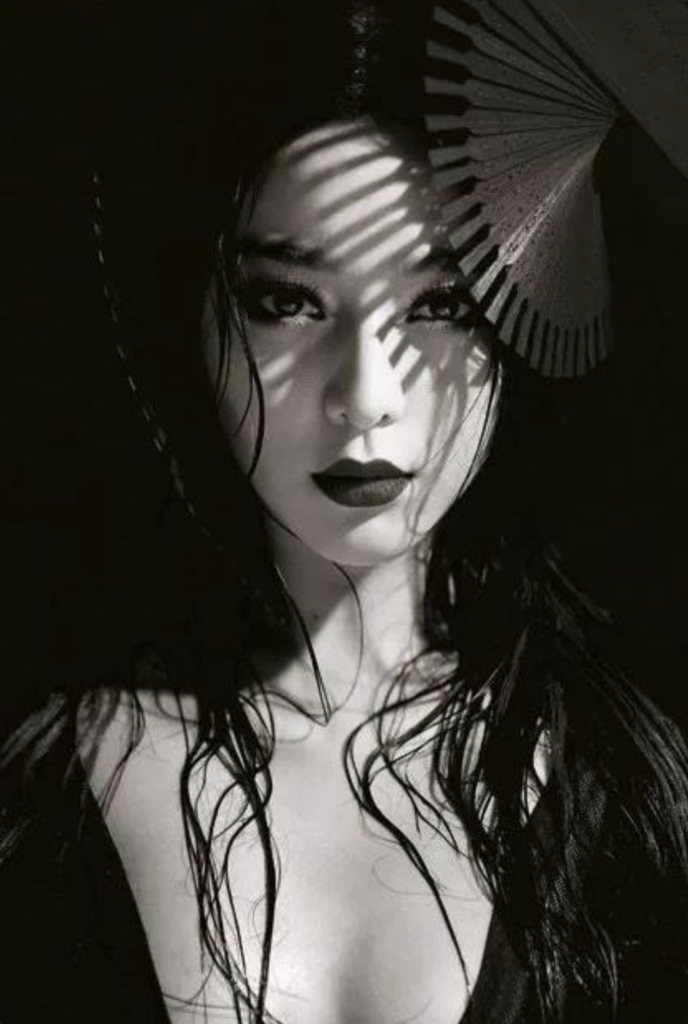
And here’s the thing: finding a really good reference isn’t easy. You need good lighting, strong contrast, a clear silhouette, high image quality, and a pose that actually works. All of those things matter. That’s why so many tattoo artists ended up using the exact same references.
Here’s one reference
…and then here’s hundreds of tattoos built from that exact reference
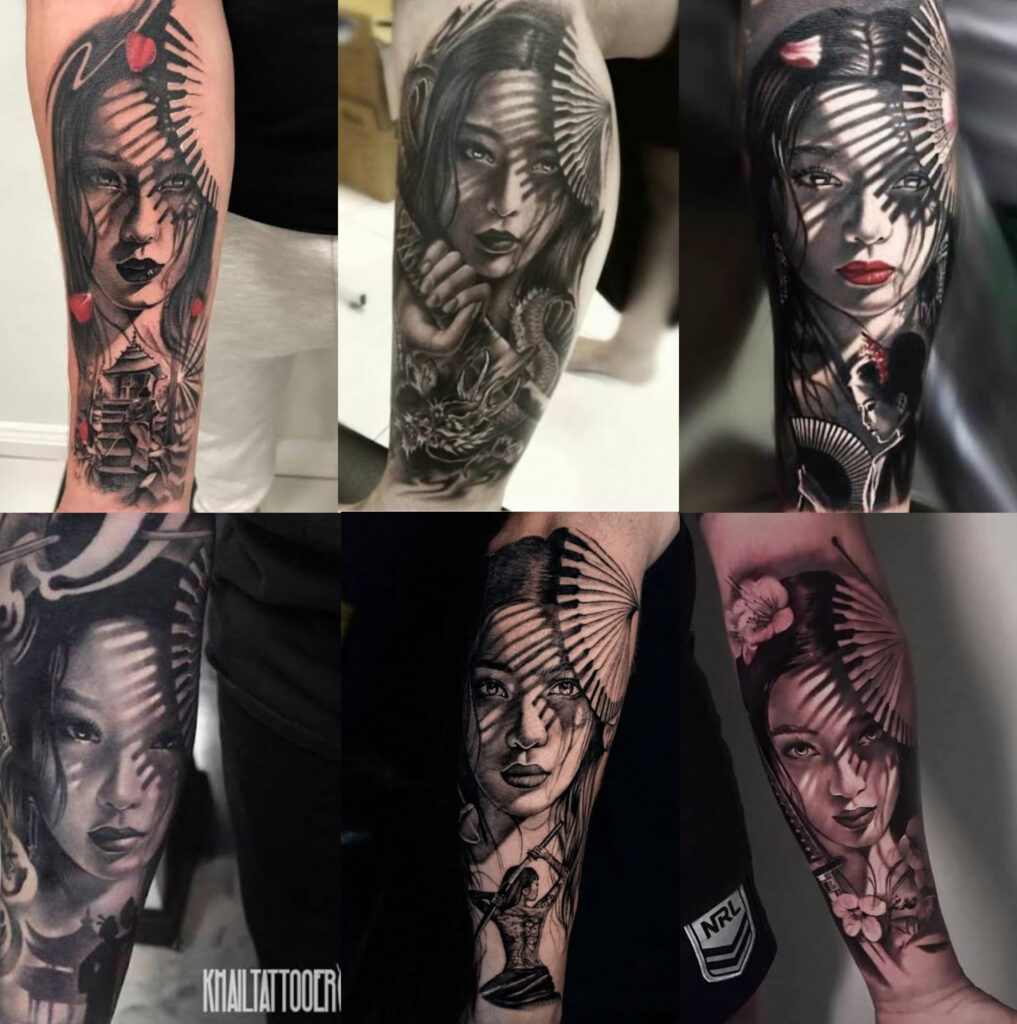
People still received “custom” tattoos. There was no AI. But were those references actually unique? Not really.
Because expecting every artist to hire a model, build a set, organize professional lighting, understand photography, and create a completely original photo shoot for every single tattoo project simply wasn’t realistic.
And this isn’t me saying, “Things were worse back then.” Not at all. That’s simply how the industry worked.
There were definitely positives to that process. Searching through references built an incredible visual library in your head. It shaped your artistic taste. It introduced you to artists you admired and inspired you to grow.
I started tattooing long before AI existed, so I went through that entire process myself. I can’t imagine developing artistic taste any other way. You look at other artists’ work and slowly figure out what you like, what you don’t, what inspires you, and what you’d do differently. To me, AI hasn’t really changed that part of the process.
So what actually changed with AI?
What changed is this: instead of spending hours searching for references (for me, that used to take anywhere from one to three or even four hours on average), we can now create them ourselves. Instead of hunting for the right pose, we describe it. Instead of hoping to find the lighting we need, we tell the AI what kind of lighting we want. So… does that make everything faster and easier? Well… not really 
AI is still a pretty complicated tool, and it rarely gives you exactly what you need on the first try. In reality, we’ve simply replaced one part of the job with another. Instead of spending hours searching for reference material, we’re now spending that time creating it.
Here’s the part a lot of people misunderstand. AI isn’t a magic button that spits out a finished tattoo design. It has no understanding of your client’s anatomy (and yes, every body is different). It doesn’t know your artistic style or the creative choices you’d make. It has no sense of composition, and it constantly makes mistakes that need to be corrected. If you know what you’re doing, you’ll spot those mistakes immediately.
Personally, I have never managed to pull a fully finished tattoo design out of an AI that I could simply tattoo as-is and proudly put into my portfolio.
Now let’s imagine AI really does save some time. Does that suddenly make creating a tattoo design easy? Hell no. Instead of spending hours searching for the perfect reference photo, I can generate one. But the time I save doesn’t just disappear. It gets invested somewhere else. Now I’m asking questions like:
How can I make this composition stronger?
How can I push my style further?
How can I make this idea fit this specific person’s anatomy better?
How can I improve readability?
How do I balance the amount of detail?
How do I make the focal point stronger?
And about a thousand other questions!!!
So if you ask me, AI hasn’t reduced the amount of work. It simply gave professional tattoo artists more room to improve things that there was never enough time for before.
There’s another thing people rarely think about: learning to use AI is work too. It costs money, it takes time and practice. Honestly, it’s no different from Photoshop years ago. Sure, almost anyone can learn the basic tools. But producing something genuinely good takes time, experience, and a deep understanding of the software. For some reason, people often dismiss that effort as if learning a completely new professional tool somehow doesn’t count.
Now, to be fair, I don’t want to be one of those people who only talks about the advantages of AI. I think it’s only fair to talk about the downsides too. Although, to be honest, most of those downsides aren’t really about AI. They’re about the artist.
AI is just a tool. A fork is a tool too. You can use it to eat dinner, or you can stab your neighbor in the eye with it. The fork itself isn’t the problem. The person using it is.
If an artist lets AI make every creative decision, stops learning, stops thinking, stops looking for inspiration, and blindly copies whatever it generates without understanding composition, anatomy, or how tattoos actually work on the human body… then yes, that’s a problem. AI isn’t going to save them.
Clients aren’t professionals, so it’s completely understandable that they can’t always tell what kind of artist they’re looking at. But you’ve probably experienced this yourself. Sometimes you see a tattoo and you can’t even explain why you love it… you just do. It simply feels right. Your eye enjoys looking at it. Most of the time, that’s because an enormous amount of thought and work went into that design.
Simply copying an AI-generated image and tattooing it isn’t going to create that same feeling. It won’t produce that “wow” factor you see in truly great work. I think you know exactly the kind of tattoos I’m talking about. You can just… feel it (or maybe that’s just years of my visual training talking )
There’s one more idea I’d like you to think about: as a tattoo client, you’re not actually paying for a drawing, you’re paying for a solution to a very complex creative problem. The design is only one piece of it. Behind that design is the tattoo artist’s technical skill, and that’s another direction where an incredible amount of time and effort goes.
Because you don’t just want a beautiful image. You want that image to be executed beautifully on skin. Think about everything that comes after the design. Years and years of practice. Understanding different skin types. Knowing how much trauma the skin can safely handle. Planning every detail so the tattoo still reads well years from now instead of turning into a blurry mess. Making adjustments directly on the body, pretty often while the tattoo is already in progress. Can AI help with any of that? At least for now… not really I think this alone should put to rest the idea that tattoo artists simply copy an AI image and suddenly have nothing left to do. Even if we imagine, purely hypothetically, that AI could generate a completely finished tattoo design, which we’ve already established it really can’t, none of those technical and artistic skills disappear. AI simply has no place in that part of the process.
So let’s wrap this up! The goal of this article was to understand why some people dislike the idea of tattoo artists using AI. I hope I’ve shared enough about what actually goes into designing a tattoo to show that AI is still only a small part of a much bigger and far more complicated process.
I’d also like to add something else. Before iPads became standard, tattoo designs were created entirely by hand. Then artists slowly started moving to computers. And when many of us switched to iPads… (shout-out to Procreate, and bless whoever created that app )… plenty of old-school tattoo artists said exactly the same things people are saying about AI today:
“Real artists don’t use iPads”
“They’re lazy”
“It’s not real art”
“This is ruining tattooing”
Look where digital art is today. It has reached an incredible level, and nobody seriously argues that digital art isn’t art anymore. The iPad didn’t make someone an artist. It became another tool. A new tool that people didn’t trust at first and that plenty of artists got shamed for using.
I think AI generation is going through a very similar phase right now. It’s not exactly the same situation, but it’s close enough to make the comparison.
Here’s what I genuinely believe: a bad artist using AI is still a bad artist. A great artist using AI is still a great artist. They might even become better if they know how to use it wisely. At the end of the day, AI is just another tool. Tools don’t make artists. Curiosity, skill, experience, and the ability to make creative decisions do.
Find the original article on Xenia’s personal blog HERE